
Samsung Galaxy S25 Ultra 5G AI Smartphone (Titanium Black, 12GB RAM, 256GB Storage), 200MP Camera, 5000mAh Ultra Long Battery, QHD+ Dynamic AMOLED 2X, Galaxy AI, Knox Security, S Pen Included
₹96,999.00 (as of October 27, 2026 17:07 GMT +05:30 - More infoProduct prices and availability are accurate as of the date/time indicated and are subject to change. Any price and availability information displayed on [relevant Amazon Site(s), as applicable] at the time of purchase will apply to the purchase of this product.)
Ambrane Multipurpose Tabletop Mobile Stand | Adjustable Angle & Height| Universal Holder for iPhone, Samsung, OnePlus & All Smartphones | Portable, Anti-Skid | for Home, Office, Bed & Gifting (Black)
₹149.00 (as of October 27, 2026 17:07 GMT +05:30 - More infoProduct prices and availability are accurate as of the date/time indicated and are subject to change. Any price and availability information displayed on [relevant Amazon Site(s), as applicable] at the time of purchase will apply to the purchase of this product.)
Watch the original video: Gen AI vs. AI Agents vs. Agentic AI: Understanding Key Differences
Disclosure: This post may contain affiliate links. If you buy through them, Informative Media may earn a small commission at no extra cost to you.
Quick Summary
- Generative AI (Gen AI) creates new content based on its training data, like text or images.
- AI Agents use tools and external data to perform specific tasks, going beyond internal knowledge.
- Agentic AI orchestrates multiple AI agents to achieve complex, autonomous goals.
- Understanding these distinctions helps in correctly identifying and utilizing advanced AI technologies.
Amazon Finds
Recommended Products
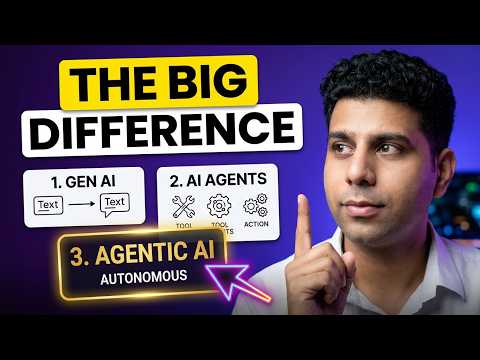
The world of Artificial Intelligence is moving at lightning speed, and keeping up with the terminology can feel like a full-time job. If you’ve found yourself scratching your head trying to differentiate between Generative AI (Gen AI), AI Agents, and Agentic AI, you’re not alone. These terms are often used interchangeably, but they represent distinct concepts within the AI ecosystem. To help you navigate this complex terrain, we’re breaking down the core differences, drawing insights from essential guides like the one you can find in this YouTube video.
The Core of Generative AI (Gen AI)
At its heart, Generative AI, or Gen AI, is about creation. Think of models like ChatGPT when it writes a poem or DALL-E when it generates an image. Gen AI excels at producing novel content – text, images, code, music, and more – based on the vast datasets it was trained on. Its primary function is to learn patterns and structures from existing data and then use that knowledge to generate something new. However, Gen AI typically operates within its internal knowledge base and doesn’t inherently interact with external tools or real-time information unless specifically prompted or integrated into a larger system.
Introducing AI Agents and External Tools
This is where things start to get more dynamic. An AI Agent is designed to perform specific tasks. Unlike Gen AI, which primarily creates, an AI Agent can *act*. It’s equipped with capabilities to interact with external tools, access real-time data, and execute actions based on a given objective. For example, an AI agent might be tasked with booking a flight. To do this, it wouldn’t just generate text about flights; it would likely need to access flight booking websites, compare prices using real-time data, and potentially interact with booking APIs. This reliance on external tools and information is a key differentiator from pure Gen AI.
Demystifying Agentic AI and Autonomous Workflows
Agentic AI takes the concept of AI Agents a step further by focusing on orchestration and autonomy. Agentic AI involves systems where multiple AI agents (or a single sophisticated agent) can work together to achieve complex goals with minimal human intervention. Imagine a scenario where an AI Agent detects a potential cybersecurity threat. An Agentic AI system might then coordinate a series of actions: one agent could analyze the threat’s origin, another could isolate affected systems, and a third could generate a report for human review. This creates autonomous workflows where agents collaborate and adapt to solve multifaceted problems. It’s about building systems that can plan, reason, and execute multi-step processes independently.
Key Differences at a Glance
To summarize, the distinctions are significant:
- Gen AI: Focuses on creation of new content based on training data.
- AI Agents: Focuses on action and task completion using external tools and data.
- Agentic AI: Focuses on autonomy and complex workflow orchestration involving multiple agents.
Practical Applications and The Future
Understanding these differences is crucial for developers and enthusiasts alike. For instance, while Gen AI can draft an email, an AI Agent could draft the email, check your calendar for availability, and schedule it using your email client. An Agentic AI system could then oversee multiple such tasks across different departments, optimizing workflows. As AI continues to evolve, these capabilities will blend and become more sophisticated. Learning to unlock AI’s full potential requires grasping these foundational concepts.
Frequently Asked Questions
Is ChatGPT a Generative AI or an AI Agent?
ChatGPT, in its core form, is a Generative AI model designed for natural language processing and text generation. However, when integrated with plugins or external tools, it can function more like an AI Agent by accessing and utilizing external information or performing actions.
Can Gen AI be used to build AI Agents?
Yes, Generative AI models can be a core component of an AI Agent. The Gen AI might be used for understanding complex instructions or generating natural language responses, while other parts of the agent handle tool integration and task execution.
What is the main goal of Agentic AI?
The main goal of Agentic AI is to enable AI systems to perform complex tasks autonomously by coordinating multiple AI agents, planning, reasoning, and executing multi-step workflows with minimal human oversight.
Conclusion
The distinctions between Gen AI, AI Agents, and Agentic AI are fundamental to understanding the current and future state of artificial intelligence. While Gen AI creates, AI Agents act, and Agentic AI orchestrates. As these technologies converge and advance, a clear understanding will empower you to better grasp, implement, and innovate with AI. Keep exploring and experimenting!
Apple iPhone 16 128 GB: 5G Mobile Phone with Camera Control, A18 Chip and a Big Boost in Battery Life. Works with AirPods; Black
₹76,999.00 (as of October 27, 2026 17:07 GMT +05:30 - More infoProduct prices and availability are accurate as of the date/time indicated and are subject to change. Any price and availability information displayed on [relevant Amazon Site(s), as applicable] at the time of purchase will apply to the purchase of this product.)